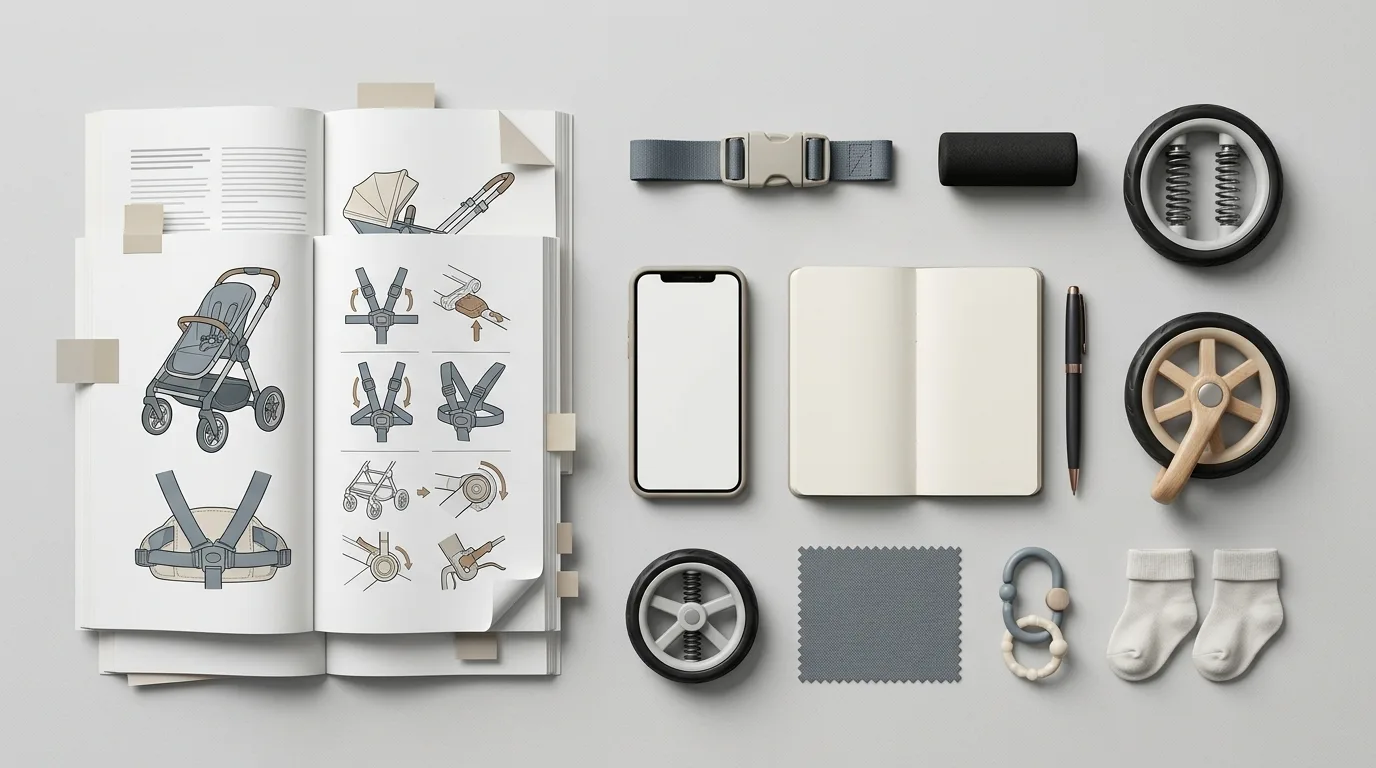
Standard stroller safety: guidance and known risks
Updated
Summary
Every standard stroller sold in the US already clears the mandatory federal
tests before it reaches you
(The Bump, 2026), so the
danger you actually control is how it gets used. StrollerWise's read of 8 safety
sources finds the recurring hazards are ordinary — a tipped frame, a loose harness,
a brake skipped on a slope, an unchecked recall — and each has a one-line habit
that removes it
(BabyGearLab, 2026).
The safety terms behind the guidance
A stroller safety claim is a stack of separate parts, and the ones that fail in
real life are behavioral, not structural
(BabyGearLab, 2026).
The terms below are the vocabulary every risk on this page is built from.
Five-point harness
A five-point harness is the restraint the AAP names first and reviewers call the
gold standard, holding a child at both shoulders, both hips, and a crotch strap
(The Bump, 2026). A
no-rethread version re-sizes without unthreading straps, which is why it recurs on
newborn-to-toddler frames
(Bambi Baby, 2026).
Parking brake
A parking brake is the wheel-locking mechanism that holds a stroller still, and the
AAP treats a brake that locks both wheels as safer than one that locks a single
wheel
(The Bump, 2026).
Deceleration brake
A deceleration brake is a hand-operated brake on the handlebar that gives better
control going downhill, usually found on jogging strollers
(The Bump, 2026), and one
jogging model pairs it with a wrist strap and a foot brake
(Bambi Baby, 2026).
Tip-over resistance
Tip-over resistance is the property marketing never quotes: how far a loaded frame
can lean before it topples. One lab captures it directly as a sideways tip-over
angle
(BabyGearLab, 2026),
and the AAP ties it to a wide wheelbase
(The Bump, 2026).
Entrapment
Entrapment is the hazard where a moving part or fold catches a finger or limb; the
EN 1888 test assesses any area that may become trapped, using probes from the size
of a child's finger to the head and buttocks
(Skyline Instruments, 2026).
Recall
A recall is the public safety action that removes an already-sold model from
compliance, which is why reviewers tell buyers to check a stroller against the CPSC
and Recalls.gov records before use
(The Bump, 2026).
Operating envelope
The operating envelope is the set of declared limits — a maximum occupant weight, a
maximum height, an age floor — and exceeding it voids the safety claim; a lab-tested
frame lists a 45 lb maximum
(BabyGearLab, 2026).
Secondhand inspection
A secondhand inspection is the pre-purchase check reviewers require on a used
stroller: confirm the wheels, brakes, straps and seat-recline features all still
work, then check the recall record
(The Bump, 2026) — the same
brand-by-brand check we run in
is there a recall on Baby Trend strollers.
The known risks, and the habit that removes each
Side-to-side tipping is the failure mode a lab measures directly, because a frame
can be tipped by an uneven load or by a toddler climbing in unassisted
(BabyGearLab, 2026).
Each row below pairs a real, sourced hazard with the single habit that defuses it.
Known risk
Why it happens
The habit that removes it
Source
Side-to-side tipping
A high or uneven load, or a toddler climbing in and out unassisted, can tip a frame sideways
Load the basket low, never hang weight off the handles, and buckle the child before they climb
Safe-use limits — exceeding them voids the safety claim
Every certification is a conditional pass: it holds only inside the declared limits,
so the numbers below are the boundary you keep the stroller inside
(Babylist, 2026).
The harness is the single feature reviewers and the AAP name first, but every part
below earns its place by removing one specific risk
(The Bump, 2026).
Feature
The risk it removes
Source
Five-point harness
A child slipping the restraint — held at both shoulders and hips; no-rethread versions re-fit without unthreading
The mandatory tests are the widest layer because every model clears them before sale
(The Bump, 2026); the narrow
bottom layer — how you buckle the harness and set the brake on every outing — is the
part a certificate cannot control
(BabyGearLab, 2026).
How the hazards actually get tested
A test method is the only thing that turns a safety adjective into evidence, and the
labs measure the exact hazards this page lists
(Skyline Instruments, 2026).
Hazard tested
How it is measured
Source
Tipping
A sideways tip-over angle test ranks which frames are tippiest
One lab has tested more than 180 strollers, 60 strollers in its latest round; Consumer Reports rates 110 strollers with a certified child passenger safety technician, and The Bump built its guidance from over 300 parents
A safe stroller is a frame that clears the CPSC baseline, so "meets safety standards"
is the floor every US model already reaches, not a habit that protects your child
(The Bump, 2026). Compliance is
the floor; the real risk is a set of daily habits. Where the sources look like they
disagree they are measuring different things: a lab reports a measured tip-over angle
and a 200-cycle brake test
(Skyline Instruments, 2026),
while a manufacturer listing reports a declared harness and weight envelope
(Babylist, 2026)
— the difference reflects methodology, one independently tested and one self-declared.
The habit that matters most is the harness. A lab's sharpest warning is not about
hardware at all: it is that net-and-strap restraints get used improperly over time as
parents grow complacent
(BabyGearLab, 2026),
which is why the five-point harness only works when it is pulled snug every single ride
(The Bump, 2026). A brake left off
is the second habit: the AAP prefers a brake that locks both wheels, and a deceleration
brake exists specifically for the downhill moment when a foot brake is not enough
(Baby Trend, 2026).
The two habits owners skip most are the cheapest. Checking a model against the CPSC and
Recalls.gov records takes a minute and catches an already-sold frame that has lost
compliance
(The Bump, 2026). Buying used is
fine on a budget, but only after inspecting the wheels, brakes, straps and recline and
confirming the same recall record — the exact checks a secondhand frame most often fails
(BabyGearLab, 2026).
When you are unsure about…
Do this
Source
Whether the harness is tight enough
Snug the five-point harness at both shoulders every ride; treat a loose strap as no restraint
StrollerWise found no hazard on this list that a certificate prevents on its own — every
one is closed by a habit at the point of use. The verdict is a single rule: treat the
factory tests as the floor, then own the four habits — buckle, brake, stay inside the
limits, and check the recall record — because that is where a standard stroller is
actually made safe
(Consumer Reports, 2026).
Methodology
This page is a synthesis of 8 sources spanning independent lab testing, a
test-equipment standards write-up, an institutional ratings body, and manufacturer and
owner listings — BabyGearLab, The Bump, Baby Trend, Bambi Baby, Babylist, Parenthood
Pro, Skyline Instruments, and Consumer Reports — grouped into 45 findings. We separated
the hazards a buyer controls at the point of use from the mandatory tests a stroller has
already passed, because conflating the two is what makes marketing sound like safety
(The Bump, 2026). Every figure
traces to a source we retrieved and content-hash verified; we quote each source's own
wording rather than our own testing, because we synthesize published reviews and
standards write-ups alongside real owner reports — we do not run a lab
(BabyGearLab, 2026).
[1]"Independent stroller reviewers ground their safe-use advice in guidance from the American Academy of Pediatrics (AAP) and the U.S. Consumer Product Safety Commission (CPSC)."https://www.thebump.com/a/best-strollers Verified July 4, 2026.
[2]"AAP guidance says a safe infant stroller pairs a five-point harness and reliable brakes with a wide base that helps prevent tipping."https://www.thebump.com/a/best-strollers Verified July 4, 2026.
[3]"Every stroller sold in the United States must already meet the CPSC federal safety standards before sale."https://www.thebump.com/a/best-strollers Verified July 4, 2026.
[6]"Buyers should check a model against the CPSC and Recalls.gov records to confirm it has not been recalled and still meets current stroller safety requirements."https://www.thebump.com/a/best-strollers Verified July 4, 2026.
[7]"Before buying a used stroller, reviewers say to inspect the model and confirm its wheels, brakes, straps and seat-recline features all still work."https://www.thebump.com/a/best-strollers Verified July 4, 2026.
[8]"A twist hand-brake on the handlebar gives better control going downhill, a feature usually found on jogging strollers."https://www.thebump.com/a/best-strollers Verified July 4, 2026.
[30]"Under EN 1888 a test lab checks any areas on the stroller that could trap a child, using probes ranging from the size of a child's finger to their head and buttocks."https://www.skylineinstruments.com/News-98.html Verified July 4, 2026.